import equinox as eqx
import jax
import jax.numpy as jnp
import jax.random as rng
import matplotlib.pyplot as plt

# training deps
import optax
from tqdm import tqdm

import stochastix as stx

key = rng.PRNGKey(42)

plt.rcParams['font.size'] = 18
/Users/francesco/Documents/GitHub/stochastix/stochastix/utils/__init__.py:3: FutureWarning: The 'stochastix.utils.optimization' module is experimental and it may change or be removed without notice in future versions.
  from . import nn, optimization, visualization
Positive Self-Loop Gene Expression#
The model consists of four key reactions:
- Transcription: DNA → mRNA (Hill activator kinetics, \(k_{v0} + k_v \frac{K^n}{K^n + P^n}\))
- Translation: mRNA → mRNA + Protein (rate constant \(k_p\))
- mRNA degradation: mRNA → ∅ (rate constant \(γ_m\))
- Protein degradation: Protein → ∅ (rate constant \(γ_p\))
This simple model captures the essential dynamics of positively self-regulating gene expression and is one of the classic network motifs. The model can be simulated using stochastic simulation algorithms (SSA) or solved deterministically as an ODE system. In the stochasic regime, the model can exibith a bimodal distribution of protein levels, a characteristic that is invisible in the deterministic ODE formulation.
We will optimize this model to maximize the entropy of the final state distribution of the protein.
# Define initial parameters

log_k_v = jnp.log(0.09)
log_k_n = jnp.log(3.5)
log_k_K = jnp.log(50.0)
log_k_v0 = jnp.log(1e-2)

log_k_p = jnp.log(0.025)
log_gamma_m = jnp.log(0.01)
log_gamma_p = jnp.log(0.002)
from stochastix import Reaction, ReactionNetwork
from stochastix.kinetics import HillActivator, MassAction

network = ReactionNetwork(
    [
        Reaction(
            '0 -> mRNA',
            HillActivator(
                regulator='P',
                v=log_k_v,
                K=log_k_K,
                n=log_k_n,
                v0=log_k_v0,
                transform_v=jnp.exp,
                transform_K=jnp.exp,
                transform_n=jnp.exp,
                transform_v0=jnp.exp,
            ),
            name='Transcription',
        ),
        Reaction(
            'mRNA -> mRNA + P',
            MassAction(log_k_p, transform=jnp.exp),
            name='Translation',
        ),
        Reaction(
            'mRNA -> 0',
            MassAction(log_gamma_m, transform=jnp.exp),
            name='mRNA_deg',
        ),
        Reaction(
            'P -> 0',
            MassAction(log_gamma_p, transform=jnp.exp),
            name='Protein_deg',
        ),
    ]
)
/Users/francesco/Documents/GitHub/stochastix/stochastix/kinetics/_hill.py:84: UserWarning: `v` is negative. Please ensure the provided `transform_v` maps it to a positive value.
  warnings.warn(
/Users/francesco/Documents/GitHub/stochastix/stochastix/kinetics/_hill.py:91: UserWarning: `v0` is negative. Please ensure the provided `transform_v0` maps it to a positive value.
  warnings.warn(
x0 = jnp.array([0.0, 0.0])

max_steps = int(1.5e4)
T = 3600.0

# couple reaction network to stochastic solver in a convenient way
model = stx.StochasticModel(
    network, stx.DifferentiableDirect(), T=T, max_steps=max_steps
)
mf_model = stx.MeanFieldModel(network, T=T)
print(network)
R0 (Transcription):  0 -> mRNA         |  HillActivator
R1 (Translation):    mRNA -> P + mRNA  |  MassAction
R2 (mRNA_deg):       mRNA -> 0         |  MassAction
R3 (Protein_deg):    P -> 0            |  MassAction
Stochastic Simulations#
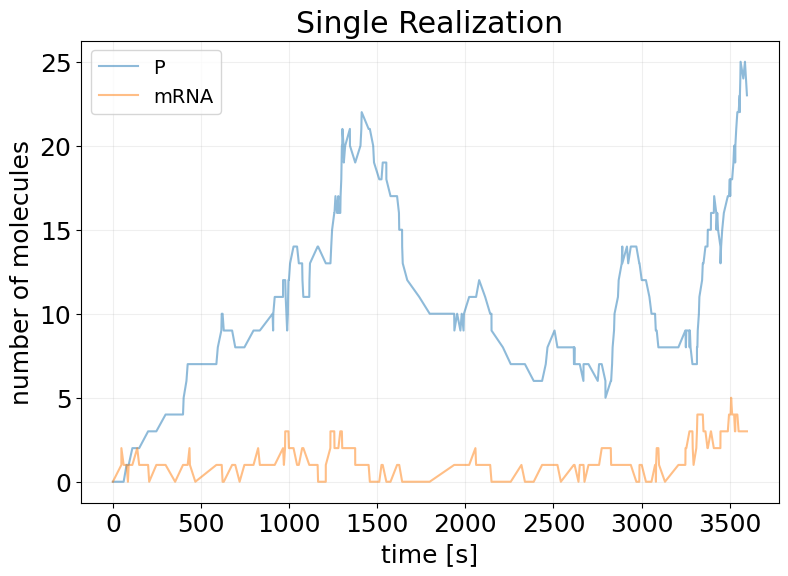
## Single Realization

key, subkey = rng.split(key)

sim_results = model(subkey, x0)

fig, ax = stx.plot_abundance_dynamic(sim_results)
ax.set_title('Single Realization')
ax.legend(fontsize=14);
## Ensemble Simulation

key, *subkeys = rng.split(key, 1001)
subkeys = jnp.array(subkeys)

x0 = jnp.array([0.0, 0.0])

sim_init_ensemble_fn = eqx.filter_vmap(model, in_axes=(0, None))
sim_init_ensemble = sim_init_ensemble_fn(subkeys, x0)

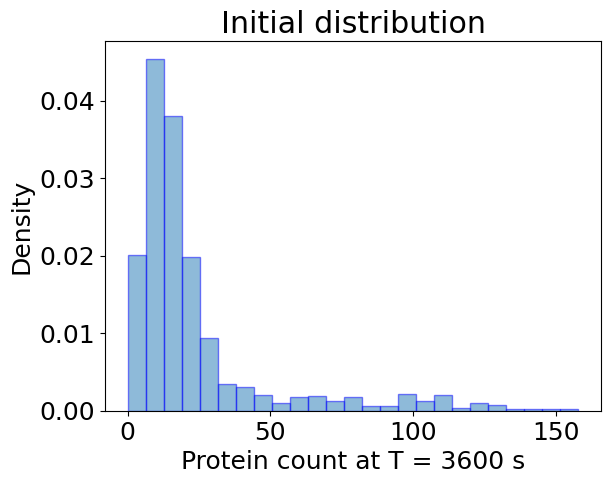
plt.hist(
    sim_init_ensemble.x[:, -1, 0],
    bins=25,
    alpha=0.5,
    label='Init.',
    density=True,
    edgecolor='b',
)

plt.xlabel(f'Protein count at T = {T:.0f} s')
plt.ylabel('Density')
plt.title('Initial distribution')
plt.show()
Maximize Entropy#
def entropy_loss(
    species: str,
    n_simulations: int = 100,
    n_bins: int = 50,
    min_max_vals: tuple[float, float] | None = None,
    negentropy: bool = False,
):
    """Compute the entropy (bits) of the final state distribution of the model."""

    def _loss(model, x, key):
        subkeys = jnp.array(rng.split(key, n_simulations))

        res = eqx.filter_vmap(model, in_axes=(0, None))(subkeys, x)

        _, probs_2d = stx.analysis.state_kde(
            res,
            species=species,
            n_grid_points=n_bins,
            min_max_vals=min_max_vals,
            kde_type='triangular',
            bw_multiplier=1.0,
        )
        # Extract first (and only) species column
        probs = probs_2d[:, 0]

        log_probs = jnp.log2(jnp.where(probs > 0, probs, 1.0))

        entropy = -jnp.sum(probs * log_probs)

        if negentropy:
            entropy = -entropy

        return entropy

    return _loss
# maximize, so minimize negent
entropy_loss_fn = entropy_loss(
    species='P',
    n_simulations=100,
    n_bins=50,
    min_max_vals=(0, 250),
    negentropy=True,
)
def train_fstate(
    key,
    model,
    x0,
    LOSS_FN,
    EPOCHS=20,
    BATCH_SIZE=32,
    LEARNING_RATE=1e-3,
):
    # trick to vmap over named arguments
    loss_and_grads = eqx.filter_value_and_grad(LOSS_FN)
    loss_and_grads = eqx.filter_vmap(loss_and_grads, in_axes=(None, None, 0))

    losses = []

    opt = optax.adam(LEARNING_RATE)
    opt_state = opt.init(eqx.filter(model, eqx.is_array))

    @eqx.filter_jit
    def make_step(model, opt_state, key):
        key, *subkeys = rng.split(key, BATCH_SIZE + 1)
        subkeys = jnp.array(subkeys)

        loss, grads = loss_and_grads(model, x0, subkeys)

        grads = jax.tree.map(lambda x: x.mean(axis=0), grads)

        updates, opt_state = opt.update(grads, opt_state, model)

        model = eqx.apply_updates(model, updates)

        return model, opt_state, loss.mean()

    epoch_subkeys = rng.split(key, EPOCHS)

    pbar = tqdm(epoch_subkeys)
    for epoch_key in pbar:
        try:
            model, opt_state, loss = make_step(model, opt_state, epoch_key)

            losses += [float(loss)]

            pbar.set_description(f'Loss: {loss:.2f}')

        except KeyboardInterrupt:
            print('Training Interrupted')
            break

    log = {'loss': losses}

    return model, log
key, train_key = rng.split(key)

reparam_trained_model, log = train_fstate(
    train_key,
    model,
    x0,
    LOSS_FN=entropy_loss_fn,
    EPOCHS=150,
    BATCH_SIZE=1,
    LEARNING_RATE=1e-3,
)
Loss: -1.46: 100%|██████████| 150/150 [03:57<00:00, 1.58s/it]
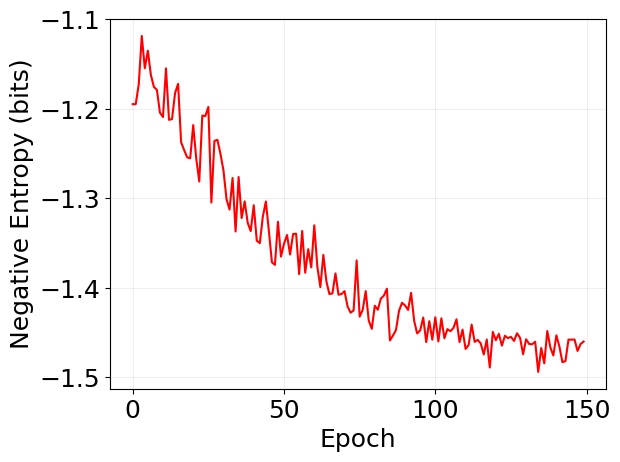
plt.plot(log['loss'], 'r')
plt.xlabel('Epoch')
plt.ylabel('Negative Entropy (bits)')

plt.grid(alpha=0.2)
## Ensemble Simulation

key, *subkeys = rng.split(key, 1001)
subkeys = jnp.array(subkeys)

x0 = jnp.array([0.0, 0.0])

sim_reparam_ensemble_fn = eqx.filter_vmap(reparam_trained_model, in_axes=(0, None))
sim_reparam_ensemble = sim_reparam_ensemble_fn(subkeys, x0)
bins, probs_2d = stx.analysis.state_kde(
    sim_init_ensemble,
    species='P',
    n_grid_points=50,
    min_max_vals=(0, 250),
    kde_type='triangular',
    bw_multiplier=0.5,
)
probs = probs_2d[:, 0]

entropy = -jnp.sum(probs * jnp.log2(probs + 1e-10))
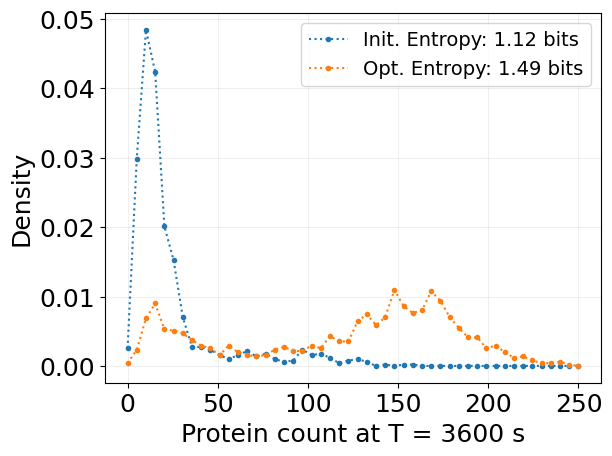
plt.plot(bins, probs, '.:', label=f'Init. Entropy: {entropy:.2f} bits')


bins, probs_2d = stx.analysis.state_kde(
    sim_reparam_ensemble,
    species='P',
    n_grid_points=50,
    min_max_vals=(0, 250),
    kde_type='triangular',
    bw_multiplier=0.5,
)
probs = probs_2d[:, 0]

entropy = stx.utils.entropy(probs, base=2)
plt.plot(bins, probs, '.:', label=f'Opt. Entropy: {entropy:.2f} bits')

plt.legend(fontsize=14)
plt.grid(alpha=0.2)
plt.xlabel(f'Protein count at T = {T:.0f} s')
plt.ylabel('Density')
plt.show()